This guide clarifies the root causes of inconsistent minimum order quantities across custom bag manufacturers. It breaks down how fabric batch limits, custom hardware MOQs, pattern development rules, and color change overhead create supplier-to-supplier gaps, distinguishes MOQ standards between ODM modified styles and OEM full-custom projects, and delivers actionable best practices for negotiating flexible small-batch terms.
By MAZ Outdoor · Buyer guide · October 21, 2026
A top recurring confusion among custom bag buyers during RFQ sourcing is inconsistent MOQ requirements across suppliers. Two manufacturers may quote visually identical custom bag styles with drastically different minimum order thresholds. Most buyers struggle to differentiate between industry-mandated MOQ constraints and arbitrary factory sales rules, leading to misaligned project budgets and sourcing expectations.
MOQ is never a subjective setting. It is a data-backed threshold calculated to offset unavoidable fixed costs including upstream material minimums, pre-production pattern and tooling investment, production changeover losses, and inventory risk exposure. Variations in factory supply chain resources, production scale, and in-house technical asset reserves create distinct MOQ frameworks across manufacturers. This guide systematically dissects all core MOQ influencing factors, clarifies ODM and OEM structural differences, and provides practical negotiation strategies compliant with small-batch custom project demands.
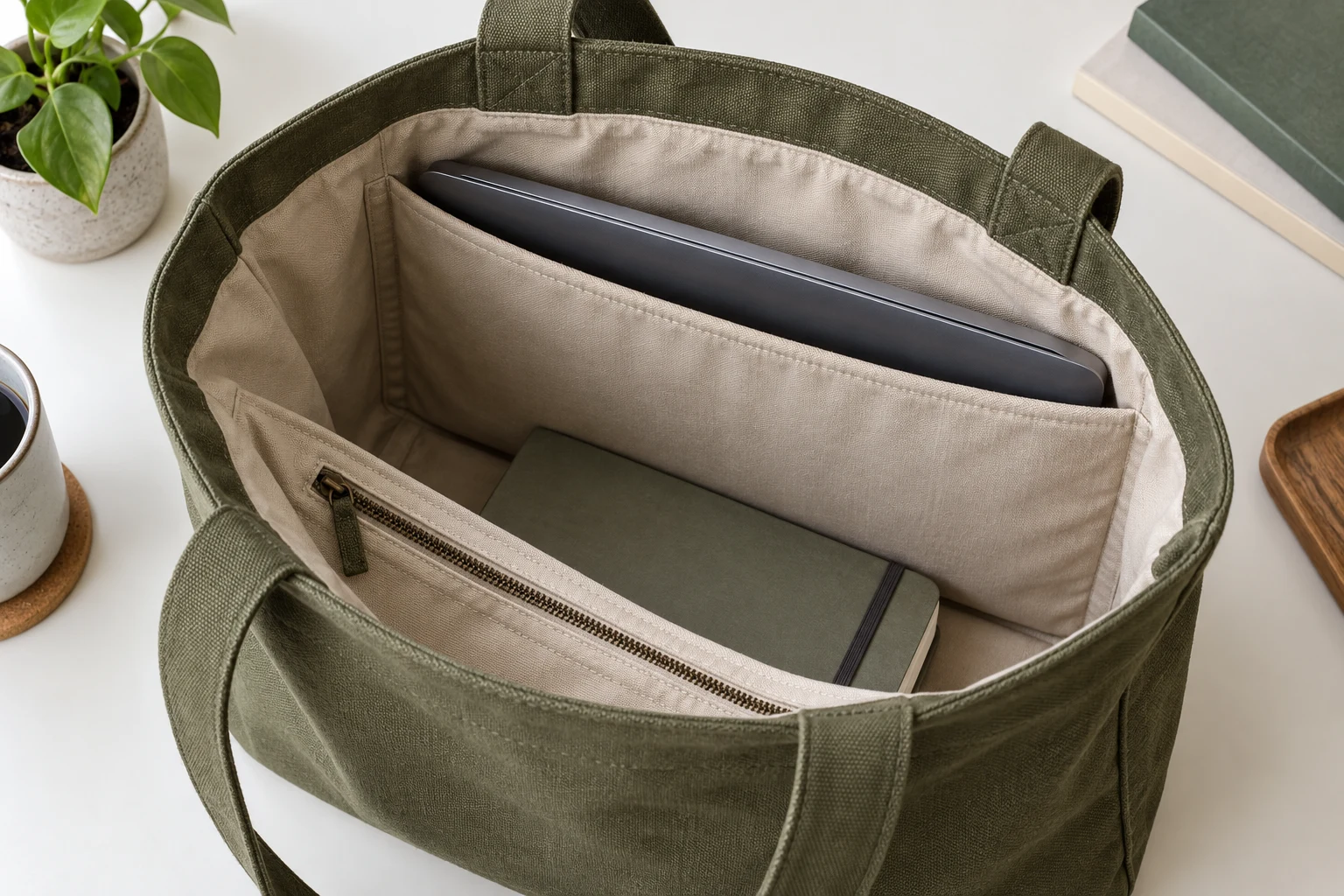
All images in this guide are AI-generated generic illustrations of custom bag production and material sourcing workflows, not photos of tested MAZ Outdoor products or on-site manufacturing standards.
Core Reason for MOQ Gaps: Fixed Costs That Small Orders Cannot Dilute
The fundamental logic of MOQ formulation is fixed-cost amortization. Every custom bag project carries non-negotiable overheads: minimum fabric batch sourcing requirements, pre-production pattern development labor, customized hardware inventory risks, and production line switching losses. High-volume bulk orders evenly distribute these fixed expenses across units, maintaining stable pricing and operational profitability. Small-batch orders lack sufficient output to dilute these overheads, so factories enforce standardized MOQ thresholds to avoid uncompensated production losses.
MOQ discrepancies primarily stem from uneven asset reserves and supply chain capabilities. Factories equipped with self-maintained fabric stock libraries and pre-stored universal hardware inventory can accommodate lower minimum orders. In contrast, factories reliant on third-party bulk raw material sourcing must strictly follow upstream supplier batch rules, resulting in inherently higher MOQ requirements for custom projects.
Four Key Factors That Cause Factory MOQ Differences
1. Fabric Sourcing Minimum Order Quantity
Fabric mills enforce fixed batch production minimums for woven, dyed, and customized textile materials, which form the bottom-line MOQ constraints for downstream bag manufacturers. Standard conventional materials, including generic polyester and plain PU fabric, feature low batch thresholds and abundant spot inventory, enabling factories to support flexible small-batch customization. Learn more about fabric specifications and sourcing standards in our custom bag fabric denier & GSM guide.
Conversely, custom color-matched fabrics, specialty textured materials, recycled functional textiles, and heavy-duty outdoor woven fabrics require dedicated bulk dyeing and mill-level batch production. Raw material mills prohibit batch splitting for small, scattered orders. Factories without reserved spot fabric inventory have to pass upstream minimum batch requirements to buyers, creating the most prevalent MOQ variation in the custom bag industry.
2. Custom Hardware Accessory MOQ Restrictions
Universal off-the-shelf hardware, including standard zippers, generic buckles, and regular pull tabs, carries no minimum order restrictions and supports flexible matching for small-batch orders. However, branded custom bag projects typically require personalized hardware configurations, such as custom engraved logo plates, exclusive custom zipper pulls, color-matched hardware, and tailored rivet fittings. These customized components are core to differentiated brand packaging, as detailed in our custom bag logo and branding methods guide.
All custom-branded hardware is subject to strict supplier MOQ regulations. Factories must procure hardware per official minimum batch standards regardless of the buyer’s final order volume. Excess customized hardware becomes idle inventory, occupying capital and warehousing resources and accumulating implicit project costs. Manufacturers with pre-developed custom hardware molds and reserved inventory can mitigate these risks and offer lower MOQs, while factories without reserved assets require higher minimum orders to offset inventory losses.
3. Zero-Base Pattern & Tooling Development Costs
Factories adopt differentiated cost amortization strategies for pattern drafting and custom die tooling, directly leading to MOQ gaps. Manufacturers with mature ODM style libraries fully reuse existing paper patterns, structural templates, and production tooling, eliminating additional pre-production investment and enabling ultra-low MOQs for minor modification orders. Standardized sample verification for these modified styles follows our custom bag sample approval checklist.
Full-spec OEM custom projects require zero-base structural design, original pattern drafting, and custom die opening, generating one-time fixed development costs. Some factories integrate development overhead into unit product pricing to support flexible small-batch orders, while others enforce higher MOQs to recover tooling and technical labor costs within a single project. These divergent cost recovery models are a key source of inconsistent supplier MOQ standards.
4. Color Switching & Batch Dyeing Loss Costs
Custom color matching introduces unavoidable production overhead, including fabric batch dyeing waste and production line color-cleaning downtime. Frequent color switching for small-batch orders significantly reduces production efficiency and elevates defective product risks, creating uncompensated operational losses for factories.
Large-scale factories focused on high-volume bulk production set higher MOQs for multi-color custom projects to avoid recurring switching losses. Small and mid-sized manufacturers specializing in small-batch customization tolerate higher proportional operational overheads, allowing them to offer lower color-split MOQs. This operational model difference explains most multi-color custom bag quotation discrepancies.
ODM Base Style vs Full Custom OEM: Obvious MOQ Differences
The most prevalent buyer misunderstanding is equating ODM modified orders with full OEM custom orders under a unified MOQ standard. These two customization modes feature entirely different cost structures, technical asset utilization rates, and pre-production investment requirements, resulting in inherent and unavoidable MOQ disparities.
| Custom Mode | MOQ Standard | Core Reason | Applicable Scenario |
|---|---|---|---|
| ODM Base Style (Minor Modification) | Low MOQ, 50–100 pcs | Reuse existing paper patterns, tooling, and mature production lines; only adjust color, logo, and partial materials; no fixed development cost pressure | Brand trial sales, promotional gifts, small-batch updated styles |
| Full Custom OEM (New Pattern) | High MOQ, 300–1000 pcs | Zero-base pattern development, independent die tooling, customized hardware and fabric batches; all fixed costs borne by a single order | Exclusive structural design, new product independent development, high-end customized series |
Most low-MOQ quotations in the industry are based on ODM modified styles. If buyers require full structural customization but reference ODM small-batch MOQs, huge pricing and threshold deviations will occur.
Buyer Practical Strategy: How to Negotiate Lower MOQ with Manufacturers
1. Prioritize ODM Modified Styles for Small Batches
Why do similar custom bags have 100pcs and 500pcs MOQ from different factories? MOQ gaps originate from unequal supply chain resources and customization modes. Factories with in-stock fabric reserves, pre-built hardware molds, and mature ODM style libraries minimize upfront investment and support low minimum orders. Manufacturers dependent on zero-base development and third-party bulk sourcing enforce higher MOQs to offset fixed operational and development losses.
2. Unify Colors and Simplify Custom Dimensions
Multi-color split orders raise MOQ significantly due to color switching losses. Appropriately unifying order colors and reducing personalized color matching can help factories save batch dyeing and line cleaning costs, allowing suppliers to relax MOQ restrictions.
3. Adopt Stock Universal Hardware Instead of Exclusive Custom Parts
Temporarily replace customized logo hardware with universal spot accessories for small-batch trial orders to avoid hardware MOQ inventory pressure. Buyers can upgrade to exclusive customized hardware for subsequent bulk reorders to balance customization needs and small-batch costs.
4. Negotiate Separately for Development and Tooling Costs
For indispensable full-custom structures, negotiate a separate one-time tooling fee with the factory. Pay independent development costs upfront to exempt bulk order MOQ restrictions. Most factories support this flexible cooperation mode for long-term brand clients.
Small-Batch Order Trade-Off: Unit Cost vs Production Lead Time
Small-batch customization with lowered MOQs is not cost-free. Buyers need to clarify the core trade-off between cost and lead time to avoid unreasonable expectations:
Cost Trade-Off: Lower MOQ means insufficient fixed cost dilution, resulting in higher single-unit prices. Small-batch orders cannot enjoy bulk procurement discounts for fabrics and hardware, with higher comprehensive production overhead.
Lead Time Trade-Off: Small-batch orders are typically scheduled as gap insertion production between high-priority bulk orders. Despite flexible customized specifications, these orders hold lower production priority, often resulting in longer actual lead times compared to standardized mass-produced orders.
Quality Stability Trade-Off: Mass production processes are more mature and stable. Small-batch customized orders have repeated process debugging, and workmanship stability relies more on manual control.
FAQ: Common MOQ Questions for Custom Bag Buyers
Why do similar custom bags have 100pcs and 500pcs MOQ from different factories? The gap comes from supply chain resources and development modes. Factories with sufficient fabric stock, reserved hardware molds and mature ODM style libraries can support low MOQs. Factories relying on upstream bulk sourcing and zero-base development have to set high minimum orders to avoid losses.
Can full-custom OEM projects support ultra-small batches? Yes, but it requires bearing independent tooling fees, higher unit material costs and manual debugging overhead. Factories will not cancel MOQ thresholds for free; ultra-small-batch full customization is only suitable for high-unit-value customized projects or brand sample layout.
Is lower factory MOQ always more cost-effective? Not exactly. Ultra-low MOQ usually comes with higher unit prices, unstable accessory matching and insertion production delays. Buyers need to balance order quantity, budget, and delivery schedule according to project attributes.
How to confirm the most reasonable MOQ for my custom project? Clarify your customization range (structure/color/hardware) first, distinguish ODM modification from OEM full customization, and ask suppliers to list MOQ constraints one by one (fabric minimums/hardware MOQ/tooling costs) to avoid opaque threshold settings.
Key Takeaway & Project Brief Guidance
Cross-factory MOQ variations are not arbitrary service differences, but objective thresholds determined by fabric batch sourcing limits, custom hardware inventory risks, zero-base pattern development overhead, and production switching losses. ODM minor modifications naturally support low MOQs via existing technical asset reuse, while full OEM customization requires higher minimum volumes to amortize one-time fixed development investment.
Buyers can effectively relax MOQ restrictions for small-batch projects by reasonably simplifying non-core customized details and adopting flexible cost negotiation solutions. Before submitting RFQs, standardize your customization scope, technical requirements, and budget expectations in your project brief, and reference our comprehensive custom bag quote checklist to obtain transparent, consistent, and comparable supplier quotations.
Share your custom bag style requirements, customization scope and target order quantity with MAZ Outdoor. We provide matched MOQ solutions, transparent cost breakdowns and flexible small-batch customization services for brand buyers.