
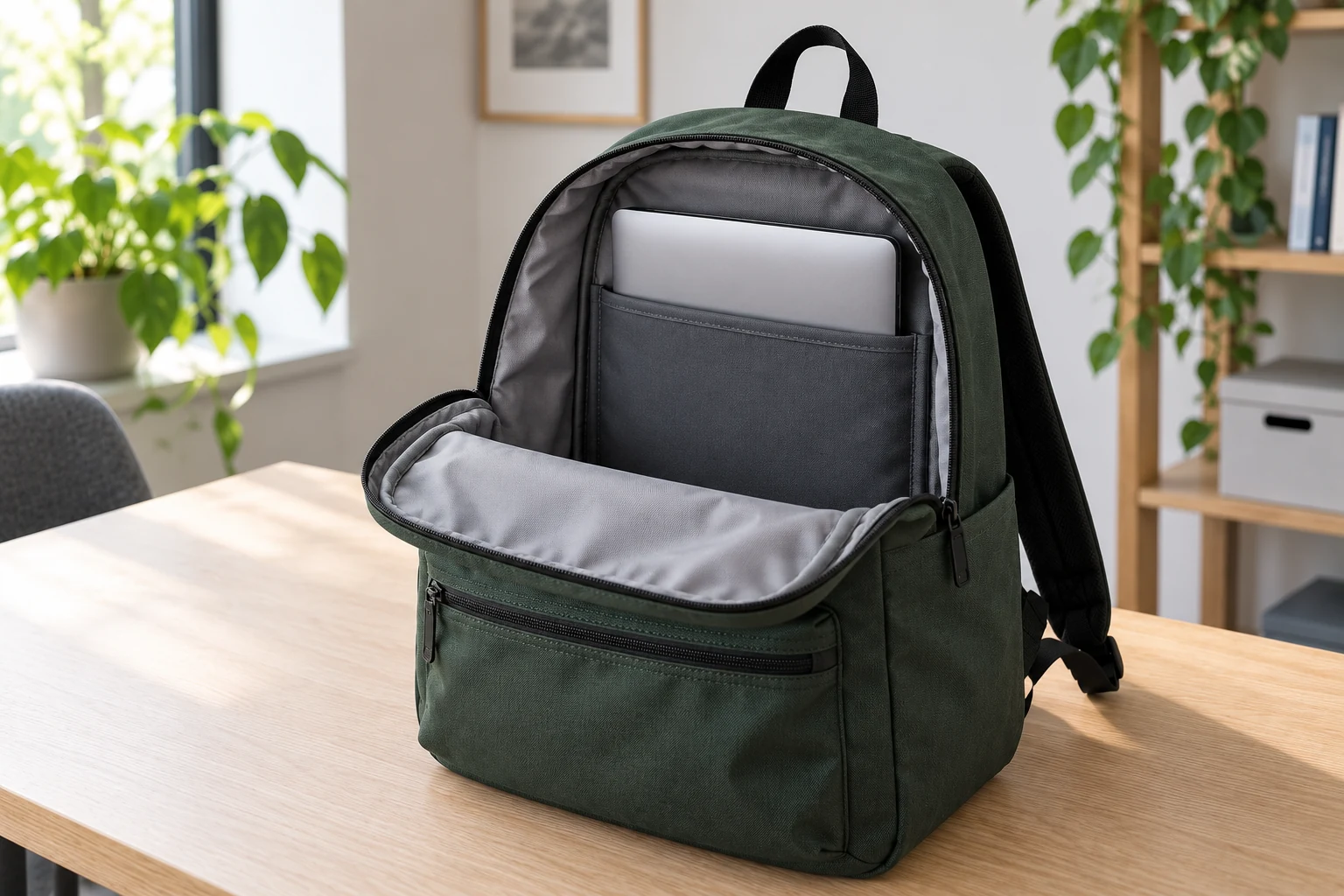
A complete buyer’s guide to custom bag internal compartment structures. Compare fixed dividers, removable hook-and-loop panels, and elastic strap layouts, avoid common capacity waste mistakes, and specify compartment details correctly in your tech pack for tennis bags, gym bags, and backpacks.
By MAZ Outdoor · Buyer guide · October 27, 2026
Most custom bag capacity complaints stem from poorly engineered internal compartment layouts, not insufficient external dimensions. Many brand buyers focus only on exterior size, overall volume, and pocket quantity during design, while overlooking how internal dividers occupy usable space, block item placement, and restrict flexible storage.
Internal compartment design directly determines a bag’s practicality, organizational logic, and end-user experience. Different bag scenarios require matched divider structures and materials; incorrect layout design leads to cramped storage, wasted internal space, and inconsistent finished product expectations. This guide systematically breaks down three mainstream compartment types, summarizes common design pitfalls, provides scenario-based layout recommendations, and standardizes tech pack drawing specifications for accurate custom bag production.
All images in this guide are AI-generated generic illustrations of internal compartment structures, not photos of tested MAZ Outdoor finished products or customized production samples.
Three Main Internal Compartment Structure Types for Custom Bags
Custom bag internal dividers fall into three standardized structural designs, each with unique functional advantages, usage limitations, and applicable scenarios. Choosing the correct compartment type avoids over-engineering or insufficient structural support for your custom project.
1. Fixed Sewn Compartment Dividers
Fixed dividers are permanently sewn internal panels that split the main bag cavity into independent fixed spaces. This structure features stable positioning, strong structural integrity, and no deformation during long-term use. It is the most reliable solution for scenarios requiring classified storage and item fixation.
Pros: Stable structure, no shifting or sagging, neat storage layout, excellent support for regular-shaped items Cons: Non-adjustable layout, fixed space ratio, easy to cause space waste when storing irregular oversized items Best for: Functional bags with fixed storage needs, professional gear bags, and structured daily backpacks
2. Hook-and-Loop Removable Compartment Dividers
Removable dividers adopt hook-and-loop (Velcro) attachment design, allowing free installation, removal, and position adjustment according to storage demands. This flexible structure balances organizational functionality and space flexibility, widely used in customizable functional bags.
Pros: Fully adjustable layout, flexible space combination, detachable for large-item storage, strong scenario adaptability Cons: Easy to shift under heavy load, hook-and-loop aging after long-term use weakens fixing stability, slightly higher production cost Best for: Multi-scene sports bags, versatile gym bags, and customized storage bags with changeable usage needs
3. Elastic Band Compartment Straps
Elastic band dividers use high-tension elastic webbing to form limit compartments, fixing slender, cylindrical, or small scattered items. This structure features ultra-thin occupancy and strong ductility, occupying minimal effective space while providing stable item restraint.
Pros: Almost no space occupation, stretchable and adaptable to different item sizes, lightweight design, low production cost Cons: No rigid support, unable to separate large-area spaces, only suitable for limiting small independent items Best for: Auxiliary partitioning, bottle/tool fixation, and secondary organizational storage in main cavities
Most Common Design Pitfall: Compartment Structures Crowd Out Usable Capacity
The biggest misunderstanding in custom compartment design is equating nominal bag volume with actual usable capacity. Internal dividers, stitching margins, and structural thickness all occupy effective internal space. Unreasonable compartment design is the primary cause of “large appearance, small storage” finished bags.
Excess fixed panels, thick multi-layer dividers, and dense elastic layouts will squeeze the main cavity space. Many buyers confirm exterior dimensions based on sample visuals but ignore the thickness of compartment materials and sewing fixed positions, resulting in finished products that cannot accommodate standard-sized conventional items.
For small-batch custom projects, unreasonable compartment modification and secondary structural adjustment will generate additional revision costs and delay lead times, as explained in our custom bag quote checklist. Optimized compartment layout prioritizes usability over excessive structural stacking.
Scenario-Based Compartment Design Recommendations (Tennis Bag / Gym Bag / Backpack)
Different usage scenarios have completely different storage logic and item attributes. Unified compartment design cannot match professional usage demands. Below are standardized layout solutions for three mainstream custom bag categories.
1. Custom Tennis Bag Compartment Layout
Tennis bags require independent wet and dry separation, racket fixation, and accessory classified storage. The core design adopts fixed main compartment + elastic auxiliary straps. Fixed divider separates racket storage area and shoe/wet clothes area to achieve wet-dry isolation; elastic bands fix tennis balls and small accessories to prevent shaking and collision during movement. Removable hook-and-loop dividers are not recommended for tennis bags, as frequent sports vibration easily causes divider displacement.
2. Custom Gym Bag Compartment Layout
Gym bags feature diverse storage items and flexible usage scenarios, suitable forhook-and-loop removable dividers + partial elastic limit straps. Removable panels freely switch between partitioned storage (sports apparel, fitness equipment, toiletries) and full large-space storage (oversized yoga mats, fitness gear). Elastic bands fix water cups, resistance bands, and small tools to improve organizational orderliness.
3. Custom Backpack Compartment Layout
Daily and functional backpacks prioritize stable layered storage, adopting multi-layer fixed main compartments + elastic auxiliary limit. Fixed dividers realize computer compartment, document compartment, and daily supplies layered storage, matching fixed daily office storage habits. Combined with internal elastic straps for pen, data cable, and water bottle fixation, balancing structure stability and practicality. For laptop carrying needs, refer to our backpack laptop fit and size guide for dimensional matching standards.
Internal Liner Material Comparison: Non-Woven vs. Nylon Compartments
Compartment material thickness and durability directly affect internal space occupancy and long-term service life. The two most common custom compartment materials have obvious applicable scenario differences.
| Compartment Material | Advantages | Disadvantages | Applicable Scenarios |
|---|---|---|---|
| Thin Non-Woven Fabric | Ultra-light weight, almost no space occupation, low cost, soft and foldable | Poor wear resistance, easy delamination and damage after long-term friction, unable to bear heavy items, weak shape retention | Light-duty promotional bags, temporary partition structure, low-load daily storage bags |
| Reinforced Nylon Fabric | High wear resistance, strong tensile resistance, stable shape retention, reusable for long term, not easy to deform | Slightly thicker, occupies tiny internal space, higher material cost than non-woven fabric | Sports functional bags, outdoor backpacks, long-term use custom commercial bags |
For high-frequency use custom bags with functional positioning, reinforced nylon compartment materials are the priority choice to avoid long-term structural damage and user experience degradation. For material durability parameter reference, check our fabric denier and GSM durability guide.
Tech Pack Drawing Specification Key Points for Compartment Customization
Most compartment inconsistencies between samples and bulk goods stem from vague drawing annotations. Simply marking “internal divider” cannot unify factory production standards. Buyers must clarify the following core details in project briefs and design drawings to avoid finished product deviation.
- Clear Compartment Dimension Parameters: Mark the height, width, and thickness of each independent compartment, clarify the effective spacing between dividers, and avoid ambiguous size descriptions
- Fixed Stitch Position Definition: Explicitly mark the sewing fixed points of dividers, specify top/bottom/side sewing ranges, and define whether to reserve flexible gaps
- Material and Thickness Requirements: Specify non-woven or nylon material, clarify fabric thickness and weaving density standards
- Structural Type Confirmation: Lock fixed sewing / hook-and-loop removable / elastic strap structure to avoid arbitrary factory replacement
- Load-Bearing Requirements: Clarify heavy-load or light-load usage scenarios to match corresponding stitching reinforcement standards, referring to our internal quality inspection standards
FAQ: Common Internal Compartment Customization Questions
Which compartment structure is most suitable for small-batch custom sports bags? Hook-and-loop removable dividers are the most cost-effective solution for small-batch sports bag customization. They meet flexible storage needs without high fixed development costs and support subsequent minor structural adjustments.
Will thick nylon compartments seriously reduce bag capacity? Reinforced nylon materials only produce negligible space occupation. Compared with thin non-woven fabrics, the improvement in durability and structural stability far exceeds the tiny capacity loss, making it more suitable for long-term commercial use.
Why do the same-size bags have different actual storage space? The difference comes from internal compartment design and sewing margin stacking. Bags with dense multi-layer dividers and full fixed stitching will have significantly smaller effective capacity than simplified compartment layout styles.
Is elastic strap compartment design suitable for large-item storage bags? No. Elastic straps only play an auxiliary limiting role and cannot provide rigid structural support. Large-item storage bags need fixed or removable partition structures to maintain stable layered storage.
Key Takeaway
Internal compartment design determines the practicality and user experience of custom bags. Fixed dividers ensure structural stability, hook-and-loop removable structures provide flexible space adjustment, and elastic straps undertake auxiliary item limiting functions. Buyers need to match compartment structures and materials based on actual usage scenarios, avoid excessive structural design that squeezes effective capacity, and standardize drawing annotation details to ensure sample and bulk product consistency.
Unreasonable internal layout is difficult to modify in the bulk production stage. Advanced structural optimization and design confirmation can effectively reduce revision risks and quality disputes.
Custom Compartment Layout Optimization Service
Our design team helps optimize internal compartment layouts for custom bags. Send your concept, design drawings, and usage scenario requirements for a professional structural review and tailored compartment solution.