
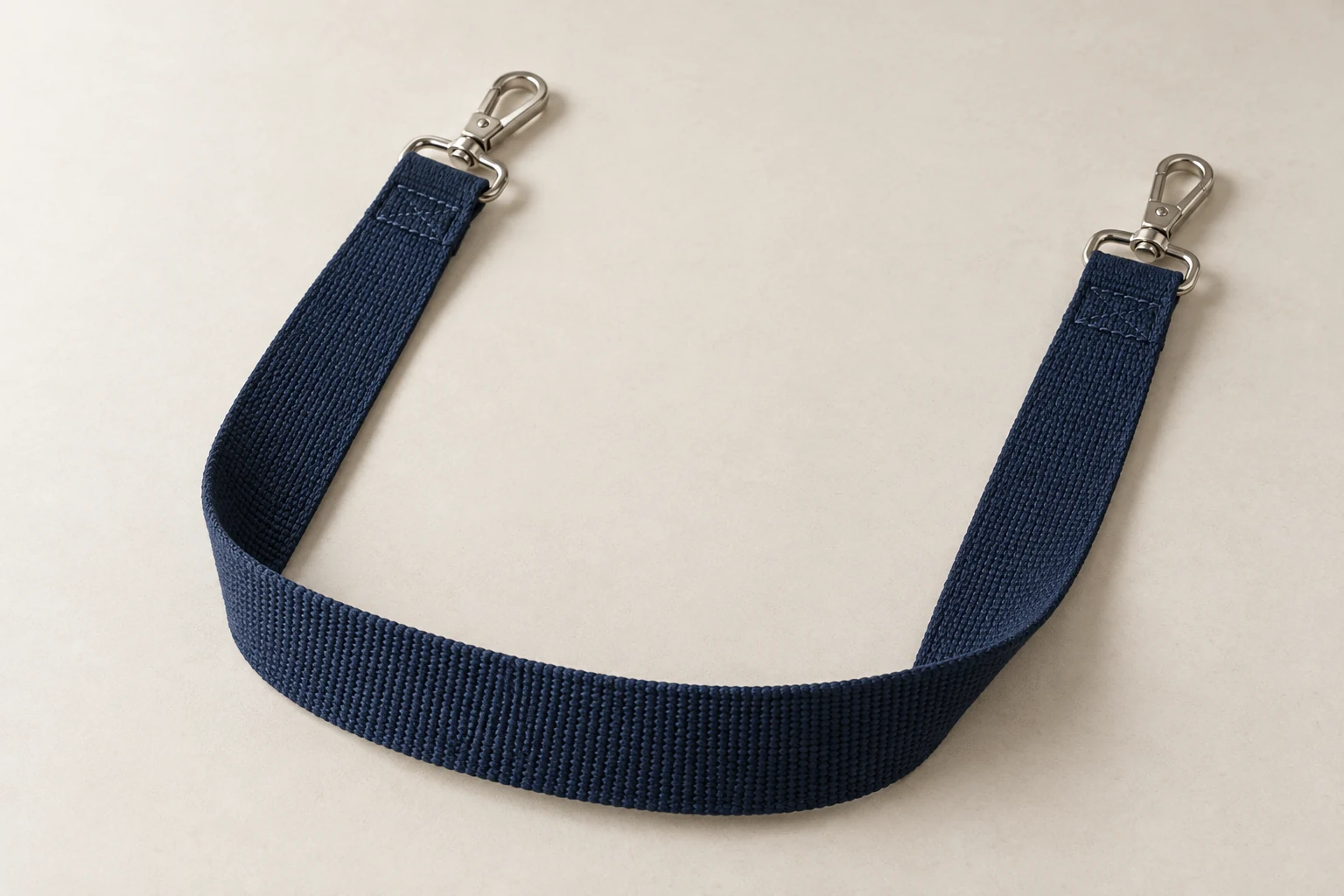
Custom bag straps should be specified as a complete carrying system: webbing, finished width and length, adjustment range, hooks or buckles, sewn end loops and attachment points on the bag. Review those parts together on a loaded sample. A strong webbing material alone does not establish the usable load capacity, comfort or durability of the finished bag.
For brand owners and procurement teams, the useful starting question is how the user will carry the product. A detachable shoulder strap for a travel bag, an adjustable crossbody strap and a short hand-carry handle require different dimensions and connections. This guide focuses on specifying the strap assembly and its interfaces before approving bulk production.
By MAZ Outdoor · Buyer guide · October 13, 2026. Images are AI-generated illustrations of generic components and construction, not actual MAZ products or test evidence.
Start with the carrying position and contents
Describe the intended carrying positions: over one shoulder, across the body, by hand or attached to another item. Include the typical contents, their arrangement and the carrying weight used for development. State whether the strap is removable and whether users will switch between modes.
Keep intended contents separate from a claimed capacity. A development sample loaded with representative items can reveal fit and handling problems, but that review is not a validated load rating. If a performance claim is required, define the verification work separately.
Identify the expected users and relevant clothing or seasonal layers for fit review. Check where the bag sits, whether the strap twists, and whether attachment points allow the intended orientation. A strap that looks proportionate on an empty bag may behave differently when the contents shift.
Specify the webbing construction, not just the fiber
A webbing specification should identify the material reference, fiber composition, weave or construction, nominal width, thickness, finish, color and agreed tolerances. Ask for swatches from the actual proposed material. “Nylon strap” or “polyester webbing” leaves several decisions open.
Compare flexibility, edge feel, visible texture and how the material folds into an end loop. Review any printed, woven or applied branding on the strap separately. A decorative construction may need its own sample because its surface and thickness can affect the connection to hardware.
Confirm whether the approved reference describes raw webbing or a finished strap with folds, stitching and fittings. MAZ Outdoor’s custom bag accessories service covers webbing, adjusters, hooks and rings as a coordinated component system. Availability and the final combination need to be confirmed against the project brief.
| Specification | Record in the brief | Review on the sample |
|---|---|---|
| Webbing | Material reference, composition, construction and finish | Surface, edges, flexibility and consistency |
| Dimensions | Finished width, thickness and defined length measurements | Fit, usable range and clearance through fittings |
| Hardware | Part reference, size, material and surface finish | Operation, mating parts and contact with fabric |
| Attachment | Loop construction, seam layout and supporting layers | Alignment, movement and the agreed assembly checks |
Choose webbing width and length together
Webbing width affects appearance, the available contact area and compatibility with fittings. It does not, by itself, establish comfort or strength. Review the actual strap on representative users with the bag loaded in its intended configuration.
For an adjustable shoulder strap, specify the minimum and maximum usable length and the measurement method. State whether length is measured between hook contact points, between sewn attachment points or by another defined reference. Include or exclude hardware consistently so suppliers quote the same assembly.
Check whether the full adjustment range remains usable after the strap is threaded through the adjuster. Review the remaining tail, any keeper and whether surplus webbing interferes with opening the bag. A catalog length for the webbing does not necessarily equal the finished strap length.
If you add a shoulder pad, define its position, dimensions and whether it can slide. Check whether it stays in the intended contact area as the bag moves. A pad is a design option to evaluate, not proof that every user will find the strap comfortable.
Match fittings to the actual strap material
Nominally matching sizes are only a starting point. The actual webbing width, thickness, folded layers and hardware clearance need to work together. Ask the component supplier to identify the intended material range and threading arrangement for the selected adjuster or buckle.
On a prototype, move the strap through its intended range. Inspect bunching, twisting, difficult adjustment and any movement of the setting during agreed handling. Check the material’s contact with bars and edges. Do not assume a new fitting is interchangeable simply because its external dimensions look similar.
For a detachable strap, review the hook and its mating ring together. Check gate access, closure, rotation and interference with the bag fabric. Identify the exact hardware references and finish rather than approving “silver hooks.” Record any proposed substitution for review before production.
Follow the strap attachment into the bag body
The carrying force passes through the strap, end loop, fitting, attachment tab and supporting bag construction. Review that entire path. A narrow tab sewn only to an outer panel may behave differently from a tab integrated with specified supporting layers, even when both look similar from outside.
Use a drawing or sample photographs to define the fold length, seam location, attachment orientation and reinforcement placement. Identify the supporting fabric and any internal layers. Specify which parts are visible so the functional construction and the appearance reference remain connected.

A box-and-cross pattern or a bar tack is a construction description, not a strength certificate. Thread, stitch settings, fabric, webbing and the actual joint all affect what needs to be evaluated. Have the supplier propose the assembly, then agree on the evidence needed for its intended use.
Review whether the tab, ring or hook can rotate into an awkward position, and whether an edge contacts or rubs the surrounding fabric. Check the finished attachment with the lining in place. An attractive outside seam does not reveal every supporting layer underneath it.
Separate material reports from assembly performance
ASTM D6775-13(2024) addresses breaking strength and elongation of textile webbing, tape and braided materials. A report using that method can describe the tested material under its stated conditions. It does not evaluate every component of a completed strap or bag.
For sewn woven-fabric seams, ASTM D1683/D1683M-22 measures seam strength with force applied perpendicular to the seam. Confirm suitability with the testing provider. A standardized fabric-seam specimen should not automatically be treated as equivalent to a folded webbing loop or a complete bag attachment.
Check material identification, specimen construction, method edition, conditioning, reported units and the result’s scope. Breaking force should not be relabeled as a finished bag’s carrying capacity. Ask for the proposed verification plan for the assembled product, including the configuration, loads or forces, duration or cycles and acceptance criteria.
Distinguish static loading, repeated handling and other conditions in that plan. Agree on the checks needed for the actual use rather than inventing a universal weight or cycle count. A one-off hand pull or a photograph of a loaded bag cannot replace documented performance evidence.
Approve custom bag straps with a repeatable review
Use the sample approval checklist to connect the accepted strap to the product revision. Record the webbing reference, finished dimensions, hardware references, fold construction, seam layout and supporting layers.
- Fit: check carrying positions, adjustment range and representative clothing with intended contents.
- Operation: connect and release fittings, adjust the strap and inspect the remaining tail.
- Assembly: compare loop folds, seam positions, alignment and reinforcement with the approved drawing.
- Evidence: identify required material reports and any complete-product checks, with their scope and limitations.
- Changes: list substitutions or revisions that require another review before bulk production.
Carry measurable requirements and defect examples into the bulk quality inspection plan. Appearance and routine function checks during lot inspection should be distinguished from any separately required strength or repeated-use testing.
Questions buyers ask about shoulder straps
Does wider webbing always make a better strap?
No universal width fits every bag. Consider the carrying position, user fit, appearance, hardware and complete attachment. Compare loaded samples and relevant evidence rather than choosing width alone.
Can a different hook be used with the same webbing?
Possibly, but review clearance, loop construction, gate access, the mating ring and the required performance evidence. Approve the new component reference instead of treating a similar finish as proof of interchangeability.
Send the complete carrying-system brief
To request a useful proposal for custom bag straps, send the bag type, intended contents, carrying positions, webbing references, finished dimensions and adjustment range. Add hardware references, attachment drawings, required evidence, quantity, destination and target delivery date.
In the MAZ Outdoor project brief, identify the decided details and the areas needing development. That gives material selection, pricing and sample approval a common reference for the complete assembly.