
By MAZ Outdoor · Published October 1, 2026
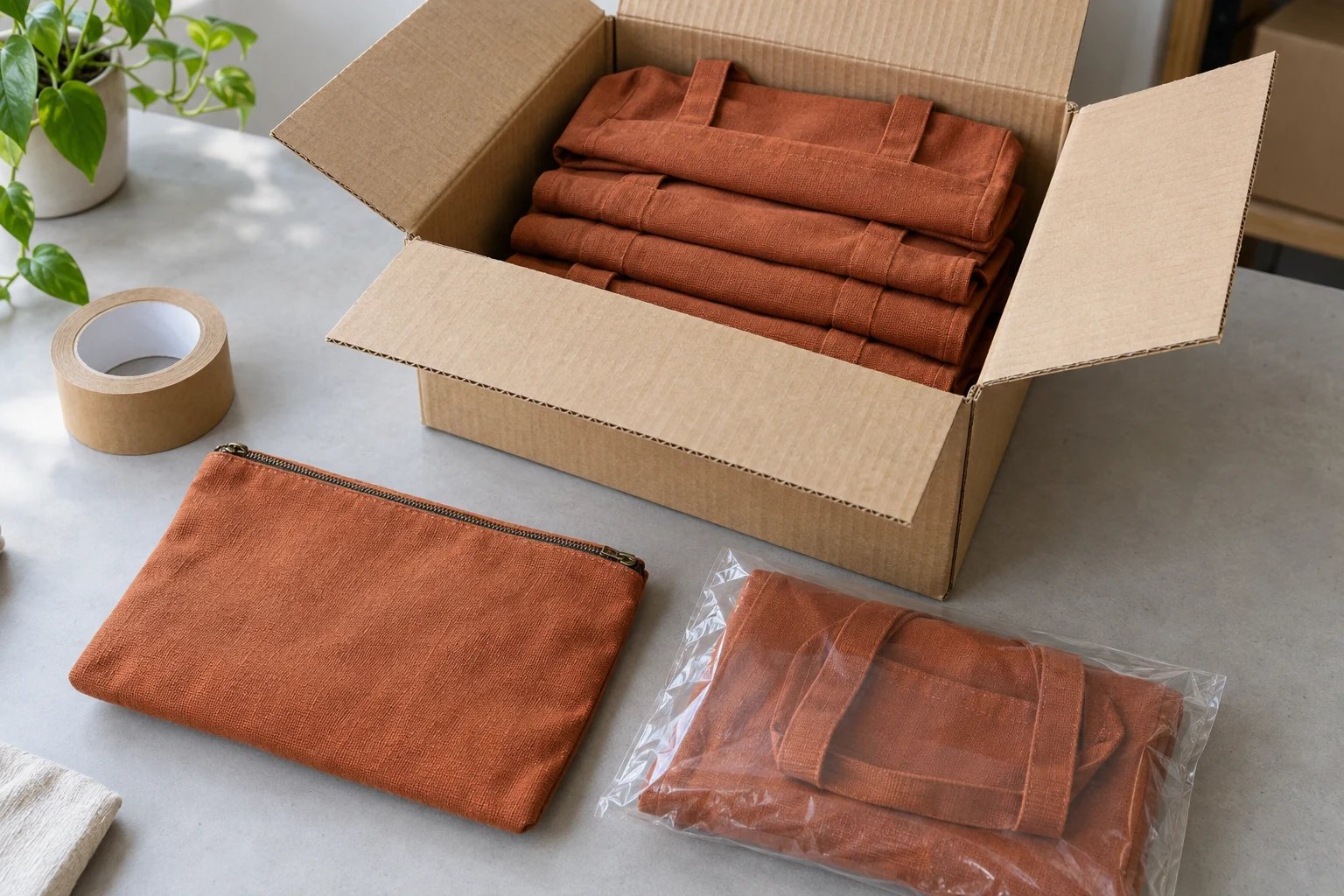
Images in this guide are AI-generated illustrations of generic packing arrangements.
A finished bag sample does not tell you how a bulk order will arrive. A tote that looks good on a table may need a different fold for retail display, while a structured backpack may need support to retain its shape. Custom bag packaging should be approved alongside the product, before the supplier commits to the final packing arrangement.
The practical starting point: define the condition in which each bag must arrive, its individual protection, the quantity and assortment in each carton, and the information your receiving team needs. Then review a packed sample and confirm the actual carton dimensions and gross weight. There is no universal pieces-per-carton number that works for every bag.
What should a custom bag packaging specification include?
A useful packing specification connects the bag, its packaging and the receiving process. “Standard export packing” leaves too much open: it does not tell the buyer whether handles are folded, whether colors are mixed, or whether cartons can be sorted without opening every box.
| Packing decision | What to confirm in writing |
|---|---|
| Bag condition | Flat, folded or shape-supported; approved folding direction and protected parts. |
| Individual protection | Sleeve, tissue, dust bag or another agreed option; closure and removal method. |
| Presentation items | Hangtag, insert or care information; artwork version and attachment position. |
| Carton contents | Pieces per carton, style and color assortment, and treatment of partial cartons. |
| Outer carton | Confirmed dimensions, gross weight, closure and agreed protective arrangement. |
| Identification | SKU, color, quantity and carton sequence; placement and required receiving format. |
| Approval evidence | Packed sample, photos, carton measurements and the revision being approved. |
Use this as a discussion checklist rather than a fixed technical standard. Your bag construction, delivery route and receiving rules determine the final choices. The packing and delivery page is a useful place to begin that discussion with MAZ Outdoor.
Choose protection around the bag’s construction
Flat or folded packing for flexible bags
Flexible totes and drawstring bags can be candidates for flat or folded packing. Check where the fold crosses a printed panel, whether handles leave impressions, and whether the first unpacked unit has the appearance you expect. A fold that reduces the carton size may be unsuitable if the buyer needs the bag ready for immediate display.
Ask the supplier to show the unpacking sequence. If someone must remove an insert, reshape the bag or flatten a fold before sale, that work belongs in your receiving plan. Avoid approving a compact fold solely from a photograph of the outside of a sealed carton.
Shape and hardware protection for structured bags
Backpacks, insulated bags and other structured styles need a different review. Inspect the base, padding, corners, straps and exposed hardware after the sample has been packed and unpacked. Decide which areas may be compressed and which should retain their form. Do not assume every structured bag needs stuffing, or that the same insert suits all sizes.
Check whether zipper pulls or buckles press against the fabric or logo area. Any protective separator should have a clear purpose and an agreed removal method. If packaging protection is critical, ask what evidence supports the arrangement for your particular shipment; an attractive sample photo alone does not establish transport performance.
Separate retail presentation from shipping protection
Individual bag packaging serves a different purpose from an outer shipping carton. The first may help keep units together, support presentation or identify a SKU. The second groups the order for transport and receiving. Approve both layers instead of treating a retail sleeve as the complete shipping solution.
For an online store, focus on what the fulfillment team needs to pick the right style and color. For retail, check the appearance after packaging is removed and the placement of tags or inserts. For event giveaways, consider how quickly staff can unpack and distribute the bags without creating unnecessary handling.
If you are adding branded tags or inserts, coordinate the artwork with the private label and logo specification. Record the approved file version, orientation and attachment location. Packaging artwork should use only claims and marks that you can substantiate; a material description or environmental claim needs its own evidence.
Confirm the assortment before setting pieces per carton
Pieces per carton is an outcome of the bag size, packing method and handling constraints. Start by deciding whether cartons will contain a single SKU or a planned mixture. A single-color carton can be easier to identify at receiving, while a mixed carton may suit a store allocation or event kit. The right answer depends on how the buyer will use the shipment.
Illustrative counting example: a 600-bag order with 300 black bags and 300 olive bags could use 30 cartons if the approved pack is 20 bags per carton. A single-color arrangement would then be 15 black cartons and 15 olive cartons. A mixed arrangement of 10 black and 10 olive per carton would also use 30 cartons, but the receiving labels and allocation process would differ. These figures illustrate the arithmetic, not a recommended carton capacity.
For a quantity that does not divide evenly, specify the partial carton separately. If a 610-bag order uses the same hypothetical 20-piece arrangement, there are 30 full cartons plus one 10-piece carton. Record the partial carton’s contents and measurements instead of assuming it matches the full cartons.
Do not approve a shipping estimate from bag quantity alone. Ask for the measured outer dimensions and gross weight of the agreed pack, then align the shipment details with the shipping arrangement. Carton count and freight cost are separate questions; transport pricing also depends on the service and shipment details.
Review a packed sample before approving the arrangement
Request a sample of the intended packing arrangement, not just a loose finished bag. Review one individually packed unit and the proposed carton layout. Where a full carton sample is impractical, agree which measurements, photos and physical samples will be used for approval, and identify what remains unverified.
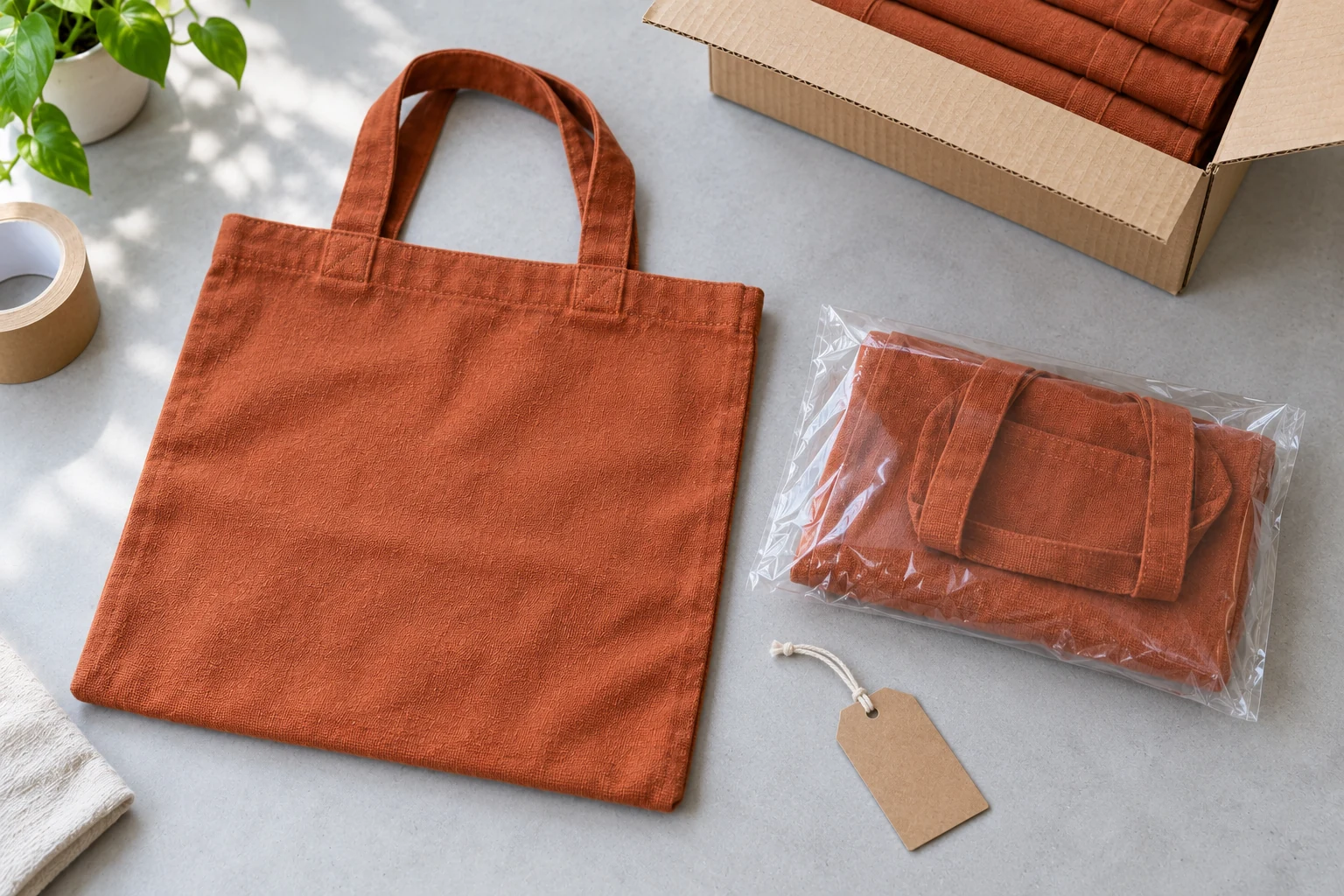
Use a short acceptance sequence that another member of your team can repeat:
- Unpack the bag and check its shape, surface, handles, logo area and hardware.
- Confirm every included item against the approved packing specification.
- Compare the carton assortment and count with the packing list.
- Review identification from the receiving team’s viewpoint, including the partial carton.
- Record carton dimensions and gross weight for the actual arrangement.
- Approve a dated revision and keep photos or samples with the order record.
A packed sample checks the proposed arrangement. It is not proof that a bulk shipment will withstand every delivery condition. If your project needs transport testing or a defined acceptance method, agree the scope, responsible party and evidence before production. Build packaging review into the sample approval process so late changes do not surprise the production team.
Make the packing list useful at receiving
The packing list should let the buyer reconcile the order without guessing. Match style names, SKU references and color descriptions to the purchase order. Show the carton sequence, quantity by carton and total by SKU. If different destinations have different allocations, agree whether they require separate identification or packing lists.
Receiving requirements can vary by warehouse, retailer or sales channel. Obtain the buyer’s current instructions before the packing specification is finalized. Label size, placement, barcode format and carton handling limits should come from the actual receiving requirements. Generic advice does not replace those instructions.
Assign responsibility for preparing the label data and checking it against the approved order. A clear handoff reduces ambiguity: the buyer supplies the required receiving format, and the supplier confirms how it will be applied to the agreed pack. Keep a readable approved example in the order record.
Questions buyers ask about bulk bag packing
Does every bag need an individual sleeve?
No. Decide according to the bag surface, presentation needs, handling and receiving process. Review the specific protection the sleeve provides and whether another arrangement achieves the same purpose. Do not add layers simply because they appear in a previous order.
Can we reduce packaging without affecting the bag?
Compare a revised packed sample with the approved condition on arrival. Check the product’s appearance and the receiving team’s handling steps. Removing an insert or changing a fold may work for one style and be unsuitable for another; confirm the revised arrangement before applying it to the bulk order.
When should packaging costs enter the quote?
Include the requested packing arrangement in the initial brief, then update the quote after the details are confirmed. Ask which packaging items, artwork preparation and packing operations are included. The custom bag quote checklist helps keep this scope alongside the product and sample requirements.
Send a packing brief with your next bag inquiry
For custom bag packaging, provide the bag style and dimensions, order quantity by SKU and color, required condition on arrival, preferred individual protection, presentation items, carton assortment, delivery destination and receiving instructions. Include reference photos when they clarify the intended fold or presentation.
Send MAZ Outdoor your bag and packing brief and ask for the proposed arrangement to be shown alongside the sample. Confirm the final contents, measurements and approval revision before the bulk order is packed.